Baba
In Ukrainian family life, baba is a familiar word for grandmother. Grandmothers often carry family memory through food, textiles, songs, language, ritual and the everyday work of keeping culture recognizable across generations.
Shared and divided pasts in Canada. Ukrainian-Canadians wrote this concept, and the invitation to shape it stands open to Indigenous co-creators from the beginning.
Baba Kokum is a working UAFest concept for exploring the long, complicated and often overlooked relationships between Ukrainian settlers and Indigenous Peoples in Canada — stories of proximity, exchange, assistance and cultural crossover that also sit inside a much larger history of colonial settlement and Indigenous dispossession.
We are making the concept public before the program is fixed because the people whose histories and cultures are involved should have the opportunity to challenge it, reshape it and decide whether it is worth building with us.
In Ukrainian family life, baba is a familiar word for grandmother. Grandmothers often carry family memory through food, textiles, songs, language, ritual and the everyday work of keeping culture recognizable across generations.
The widely used spelling kokum relates to Plains Cree kôhkom, “your grandmother.” It is a Cree kinship term, not a generic Indigenous word. That matters: the working title points to a specific Prairie history and must not be used to flatten distinct Indigenous Nations into one identity.
The title is provisional. If Indigenous collaborators tell us the name is inaccurate, too broad or simply the wrong starting point, changing it is part of doing the work properly.
Library and Archives Canada dates the arrival of the first two Ukrainian settlers in Canada to 1891. Tens of thousands followed, especially to Manitoba, Saskatchewan and Alberta. That gives Ukrainian settlement in Canada a history of more than 130 years.
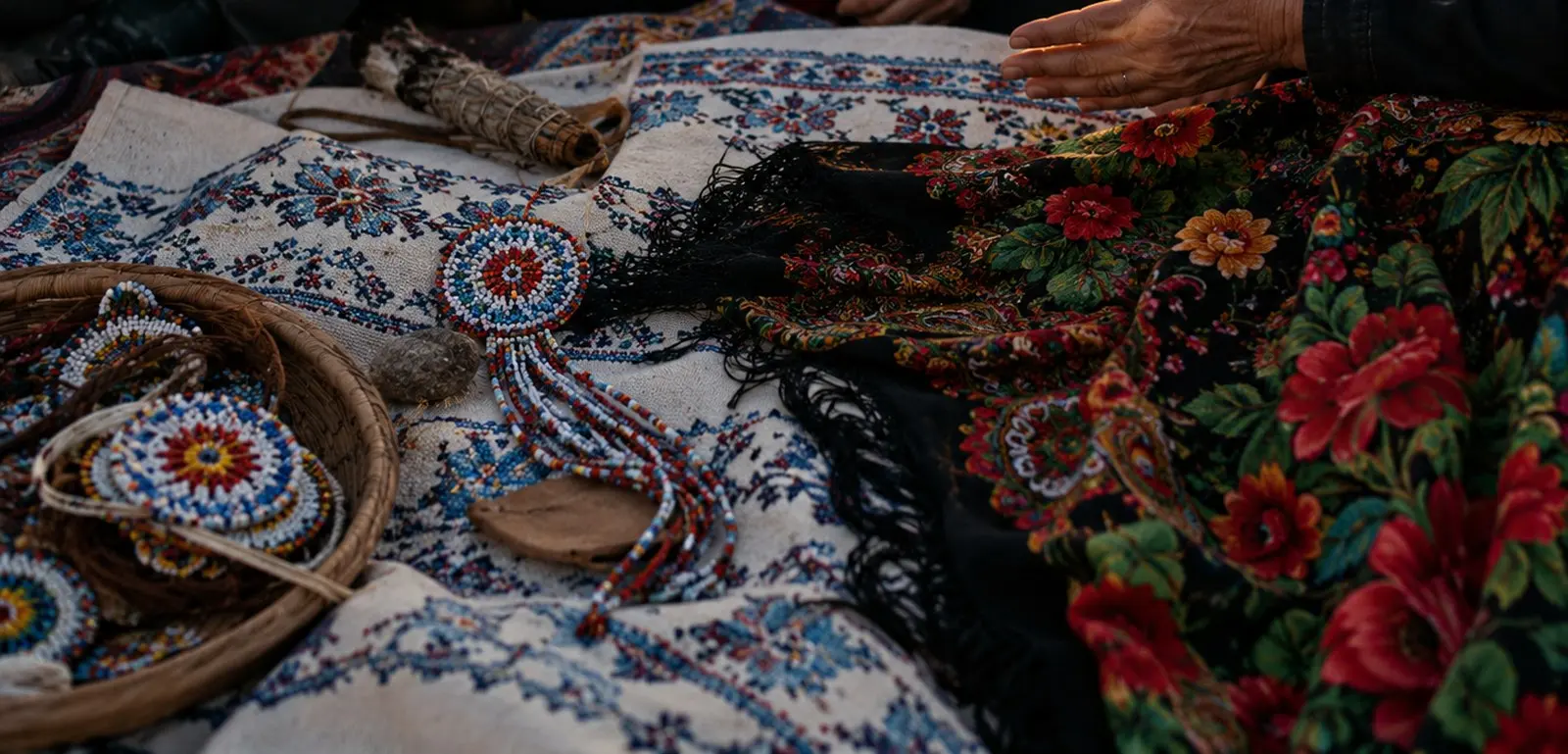
There are documented stories of Ukrainian settlers and Indigenous neighbours exchanging knowledge, labour, goods and support. Printed floral scarves circulated on the Prairies and are now widely described as kokum scarves. The flowers were already there: naturalistic floral design was established in Métis work at Red River by the 1830s, and Cree makers had taken up Métis floral patterns by the late 1820s — roughly six decades before Ukrainian settlement began. The one peer-reviewed study of the scarf declines to fix a single origin for it, and this project follows that refusal rather than the tidier version.
But a respectful project cannot turn those stories into a comforting myth. Ukrainian settlers also arrived through a Canadian settlement system that occupied Indigenous lands. Contemporary research on Ukrainian–Indigenous relations explicitly asks how Ukrainians benefited from and participated in those colonial structures while also recording meaningful relationships that existed between individuals and communities.
UAFest takes place at Riverside Park in Carleton Place. The Town of Carleton Place recognizes the area as the unceded traditional territory of the Algonquin Anishinaabe Nation. Any local relationship-building must therefore start by understanding whose land our festival is on and listening locally.
The “Kokum” part of the working title comes from Cree language and Prairie histories. We will not present Cree experience as if it were local Algonquin history, nor ask one Indigenous partner to speak for every Nation. Different parts of the project may require different relationships and different expertise.
A public exhibit or festival installation built from community-approved stories, objects, archival material and contemporary voices — with Indigenous partners deciding what belongs, what does not, and how it should be interpreted.
Ukrainian floral scarves became known in a number of Prairie Indigenous communities as kokum scarves. That visual connection can open a conversation about trade, memory, kinship and cultural adaptation — without pretending one object explains an entire relationship.
A format where Elders, Knowledge Keepers, Ukrainian-Canadian families, youth, artists and researchers can place different memories beside one another rather than forcing them into one polished narrative.
With consent, the project could grow beyond a single festival into a digital collection of interviews, photographs, research notes and community-created material that remains accessible and can keep evolving.
Textile, visual-art, storytelling or youth-learning formats may become part of the project where invited cultural practitioners want to lead them. We will not copy ceremony, regalia or cultural practices into programming ourselves.
The long-term value is not a one-off display. It is creating a repeatable way for a Ukrainian cultural organization to listen, name whose work it is, build relationships and make room for Indigenous leadership in future work.
We are publishing a question and a working framework, not presenting a finished Indigenous program for approval after the fact.
First Nations, Inuit and Métis peoples are not one culture. Cree histories on the Prairies are not interchangeable with Algonquin Anishinaabe histories in the Ottawa Valley.
Stories, names, images, recordings and cultural knowledge should only be made public with clear permission and agreed attribution, access and reuse terms.
Ceremony, sacred knowledge, language, designs and community protocols are not raw material for festival programming. Indigenous partners define the boundaries.
Cultural and professional expertise carries real value, and the project names whose work it is and what it is used for. Today everyone on the project is a volunteer, including the team. Any fee line for cultural work exists only inside a grant application that has not been submitted.
Baba Kokum is a working title. The name, framing, format and even the premise can change when the people we hope to work with tell us they should.
UAFest began in Carleton Place in 2023 and has grown into an annual Ukrainian cultural festival. In 2025, 4,000+ visitors came to Riverside Park, and the 2026 festival took place there on September 13.
We can bring event production, volunteer capacity, communications, a public website, digital storytelling tools and an existing audience. Those are useful assets, but they do not make us authorities on Indigenous history or culture. Baba Kokum only becomes credible if the cultural and historical work is built with the people who hold that knowledge.
The most useful first response may be criticism. If a term, assumption or proposed direction on this page is wrong, we would rather learn that before building around it.
Tell us what we have right, what we have wrong, what should be left alone, and what a respectful first step would look like from your community’s perspective.
info@uafest.ca · +1 (613) 621-1261
This is not presented as a complete history. These public sources establish the starting facts and, just as importantly, the need for a more careful community-led account.